Entries Tagged 'Strategy' ↓

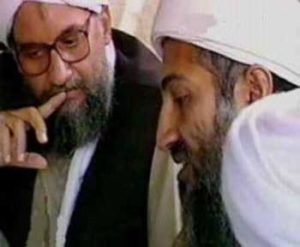
Sahab Releases Full Zawahiri Message in English

A few days ago, ARY (a Pakistani network) ran an extremely truncated version of a lengthy audio tape of Zawahiri addressing Pakistanis in English.  Yesterday, Sahab (the media production arm of al-Qaeda) released the full audio recording online (open the .pdf below for links).  Here are the interesting bits:

  • Zawahiri says at the beginning that he wants to address Pakistanis in Urdu, but he can’t speak the language.  He is speaking English to communicate with them, even though it is the language of the enemy.
  • Zawahiri’s attachment to Pakistan began in his childhood.  His grandfather was the first to translate the poetry of Muhammad Iqbal into Arabic.
  • Musharraf is a tool of the U.S.
  • Pakistan made a “strategic blunder’ when it allowed the U.S. to install Hamid Karzai in Afghanistan since Karzai is friendly to India.  Now, Pakistan has no “strategic depth” in the mountains of Afghanistan, which would be useful in a war with India.
  • How can military officers and soldiers not be bothered by Musharraf’s strategic blunders?  How can they not be bothered by killing fellow Muslims and Pakistanis?  How can they not be troubled by their defeats at the hands of the mujahids?
  • Until the mujahids in Kashmir free themselves of ISI influence, they won’t be able to liberate it.
  • The new head of the Pakistani army, Kiyani, is also an enemy of Islam like his predecessor.
  • Officers and soldiers in the Pakistani army are apostates if they fight against fellow mujahids.  Zawahiri belabors this point a great deal.
  • There are historical examples of Muslim resistance to British rule in the region, such as `Abd al-`Aziz, Ahmad Shahid, Isma`il Shahid, Shah `Abd al-Hayy, Shaykh al-Hind Mahmud al-Hasan, and his student Sayyid Husayn Ahmad Madani.
  • Zawahiri invites Pakistanis to join the jihad.  If they don’t rise up, Pakistan will become part of Greater Hindustan.

It may not come across in the summary, but Zawahiri directs a lot of his remarks to Pakistani military personnel to explain why they will have to be killed if they don’t disobey orders.  Perhaps this is a prelude to an increase of violence in Pakistan against military installations and personnel outside the tribal regions.   I better understand now why ARY cut most of the video.

If you’re interested in watching it, open the .pdf below and download it from one of the first two sections of links (the links below these are for an Urdu translation).  The password is the long string of letters and numbers above the links.

Document (Arabic): 8-16-08-ekhlaas-complete-zawahiri-english-message-to-pakistan

New Issues of Two Jihadi Journals

Issue 28 of Sada al-Jihad is out.  Articles include, “Hamas Responds Negatively to the Invitation of Shaykh Ayman al-Zawahiri” and “The Intellectual Pollution of the Followers of the Salafi-Jihadi Method.”

A new journal, Qadaya Jihadiyya (Jihadi Issues), has also be released.  The production quality is better than most of the Jihadi journals and the articles look interesting.  There is a “Strategic Issues” section, reminding me of Abu `Ubayd al-Qurashi’s column in the Ansar journal.  It has two articles: “The Islamic State of Iraq and Early Signs of American Failure” and “Regional Alliances and the Path of Jihad.”  Another section, “Thoughts of a Mujahid,” has the memoir of someone who attended the al-Faruq training camp.

Document (Arabic): 8-8-08-faloja-issue-28-of-sada-al-jihad

Document (Arabic): 8-12-08-faloja-issue-1-of-qadaya-jihadiyya

Jihadi Explains Iranian Realpolitik

Abu `Abd al-Rahman `Atiyyat Allah (possibly this person) has written a new booklet titled Ru’ya kashifa in which he tries to convince his Jihadi brethren that Iran and Hezbollah are not working with the U.S. and Israel as part of a grand conspiracy to subjugate Sunnis. Rather, he argues, Iran and its cat’s paw Hezbollah are seeking hegemony in the region. Achieving it means supporting popular Muslim causes and making temporary alliances with ideological enemies or competitors. Below is a summary:

  • It is hard to analyze Shia states and groups because of their doctrine of dissimulation (taqiyya), or concealing one’s true beliefs. p.4
  • Dissimulation is permitted in Sunni Islam if you are in danger. But the Shia make a habit of it. p.5
  • Outwardly Iran and Shia groups stress Sunni-Shia unity; embrace causes that are important to Muslims, particularly the Palestinian issue; and put Iran forward as the only authentic Islamic state, which fills a void left by the absent caliphate. p.12-14
  • Inwardly, Shia sincerely believe in Islam, but it is an Islam of their own making, not true Islam; they believe they are the only true Muslims; and they are seeking to dominate the Islamic world. p.15-16
  • “The hostility between the Rejectionists [the Shia], America, and Israel is real hostility.” p.19
  • Those who believe there is no real hostility between Iran on one side and the U.S. and Israel on the other have bought into conspiracy theories, which are a regrettable flaw in our culture. p.19
  • The hostility of Iran toward the U.S. and Israel is partly religious, in that Shi`ism retains the religious hostility toward Christians and Jews found in the true religion, Sunnism. It is also due to Iran’s desire for power. p.19
  • Iran helped the U.S. in Afghanistan and Iraq because of its self-interest–the U.S. eliminated two of its enemies, the Taliban and Saddam. This is a good example of the opportunistic and circumstantial nature of Shia politics. p.21
  • The Shia make these kind of decisions because their greatest enemy is the Sunnis. They can live with Jews and Christians, but not Sunnis. Look how Iran treats its Sunni minorities, how Hezbollah behaves toward Sunnis, and how the Shia government in Iraq has dealt with Sunni Iraqis. p.21, 24
  • Contrary to what many Jihadis say, Hezbollah is not Israel’s collaborator. But Hezbollah will talk to Israel and work with it on a limited basis if it suits Hezbollah’s interests. p.22-3
  • The Shia are pragmatic. They are willing to work with anyone regardless of their stated beliefs. This includes working with Wahhabis. p.23
  • Hezbollah supports Palestinian militants to achieve the wider aims of Iran. It has adopted a popular cause to increase its popularity. It is also filling a leadership vacuum left by other Arab states who have failed to step up. p.32-3
  • Hezbollah is a tool of both Iran and Syria. It serves their interests and policies. p.36
  • Hezbollah prevents any Sunni resistance from setting up on the Lebanese border with Israel. It has cut deals with Syria, the U.S., and even Israel to retain its control of the area. p.36

Despite the excessive focus on dissimulation (which also plagues Western analyses of Shia politics) and the Iran-wants-to-rule-Sunnis argument (does it really want to rule Indonesia?), this is a good primer on Iran’s realpolitik in the Middle East and dovetails well with the findings of an excellent new book, The Limits of Culture. That `Atiyyat Allah has to chastise his fellow Jihadis for their conspiracy thinking and their overemphasis on cultural motives when analyzing state behavior shows that they are problems for the Jihadi analytical community. Same could be said for us.

abu-abd-al-rahman-atiyyat-allah-ruya-kashifa رؤية كاشفة

Prophetic Precedents for Various Types of Warfare

This one is for all those who believe that Jihadis act strictly according to the Qur’an and the Sunna.  It’s a detailed study by Abu al-Harith al-Ansari of the various types of warfare and the prophetic precedents for each.  There are 41 kinds in all, including “media warfare,” “economic warfare,” “secret warfare,” “war of attrition,” and so forth.  If you’ve ever needed to make the argument that Islamic scripture determines Jihadi behavior, this 278-page book is for you.

Of course, you’d still have a hard time explaining why a branch of al-Qaeda in Iraq recently broke with the organization and renounced suicide attacks.

abu-al-harith-al-ansari-irshad-al-saul-ila-hurub-al-rasul إرشاد السؤول إلى حروب الرسول

Jihadi Pundit Translates, Analyzes RAND Study

Yaman Mukhaddab, a Jihadi pundit who’s appeared on this blog several times, has translated the summary of the new RAND study, How Terrorist Groups End: Lessons for Countering al Qa’ida. It’s a fast turnaround for a translation, given that the existence of the study was first reported in Western media on July 28 and Yaman finished his work on July 30.

Yaman says he has rushed to translate the document for two reasons. First, he believes that it is dangerous. RAND, he says, has finally understood that the reason al-Qaeda attacks the U.S. is to provoke it into a direct military conflict in the Middle East, which will strengthen and consolidate the mujahids and bring about greater losses for the U.S. and its allies.

Second, RAND is the go-to contractor in the U.S. for crafting the government’s response to al-Qaeda. Past RAND studies have had a huge influence in this regard and most of their recommendations have been implemented.

Yaman further argues that the next administartion will follow the plan outlined in this study. Both Republicans and Democrats want to end direct engagement with mujahids in the Middle East and use proxies and clandestine operations instead.

Since RAND’s recommendations for correcting the U.S. response to al-Qaeda derive from a scientific study of past terrorist groups, the mujahids would do well to read them so as to not fall into the enemy’s new traps. Moreover, RAND studies are public and provide an early warning of what the U.S. will do next, so the mujahids would be foolish to ignore them.

After posting his translation of the summary, Yaman offers five thoughts:

  1. The enemy has finally begun to understand.
  2. There is much in this study that torpedoes the propaganda of the enemy, which will help the mujahids.
  3. How can the enemy’s new strategy be thwarted?
  4. The RAND study is not an exercise in disinformation. But it still has some major holes that its authors haven’t perceived.
  5. The study will be implemented. Indeed, there are signs of this happening already.

In the coming weeks or months, Yaman plans to flesh out the five points above. He also intends to translate the fifth section in the complete study called “Military Force and al-Qa’ida in Iraq” since it contains much of benefit to the mujahids. Finally, Yaman hopes to translate the entire 225 page document. I’ll keep you posted.

7-30-08-yaman-mukhaddabe28099s-commentary-on-rand-study-how-terror-groups-end

Saudi Terror Arrests Summary, Government Points Finger at Iran

I’ve been collecting news stories on the terror suspects arrested in Saudi Arabia. Much of the reporting relies on Saudi security personnel and the Interior Ministry’s statement last week, so it should be read with due skepticism.

There’s a lot to discuss, but I’ll save my comments for later. For the moment it’s worth noting that, as of today, the Saudis are now injecting a new piece of information into the story: the network was taking orders and receiving money from someone in Iran:

  • The funding for the AQ cells in Saudi came from one of the major countries in the region in the form of Euros. (al-Qabas, “Oil Cell”)
  • Instructions for the cells came from the same major country in the region in which leaders of AQ sought refuge, like the Egyptian Sayf al-Adl who is currently living there. (al-Qabas, “Oil Cell”)

Below is my summary of all the data points I’ve been able to find (sources at the bottom):

The Network

  • Five networks have been captured. (al-Qabas, “Oil Cell”)
  • Of the 701 people arrested (181 of whom have been released), more than 50% are Saudi citizens. (Dhaydi, “Features”)
  • In the new batch of arrests, the demographic has shifted to Mauritania, Pakistan, Afghanistan, and Indonesia. In the past, non-Saudi militants active in the Kingdom came from mainly from Yemen, then Chad, Morocco, and Kuwait. (Dhaydi, “Features”)
  • 7 Mauritanians were among those in the “oil cell.” They were pursuing advanced degrees. One had a Master’s degree. The youngest was 35 and all of them played leadership roles. (al-Qabas, “Oil Cell”)
  • The seven Mauritanians had a “special driver” visa that enabled them to move around the country freely. (al-Qabas, “Oil Cell”)
  • The Afghans arrested were from Waziristan. (Malifi, “Africans”)
  • There were Yemenis and Iraqis in the “oil cell”. The number of Yemenis was higher than those of other nationalities in the cell. The number of Saudis in the cell is equivalent to that of the other nationalities in the cell. (al-Qabas, “Oil Cell”)
  • Only 50% of those in cell were Saudis. The rest came during pilgrimage season and did not go home. (Adnkronos, “Terror Cell”)
  • Most of the foreigners in the cell were recruited by imams in their home countries, or through the Internet. (Adnkronos, “Terror Cell”)

Recruitment

  • Because of Saudi security measures, the militants altered their methods of recruitment and their procurement of equipment. (Dhaydi, “Features”)
  • In Saudi Arabia, the main tool of recruitment is the Internet. (Dhaydi, “Features”)
  • The Eastern Province cell recruited illegal African residents to find jobs in the oil sector. (Malifi, “Africans”)
  • The recruiter network carried out organized efforts to target youth and to send them for training outside Saudi Arabia. (al-Sharq al-Awsat, “520 Arrested”; Malifi, “Africans”)

Leadership

  • There is no single leader for al-Qaeda in Saudi Arabia. (Dhaydi, “Features”)
  • A mobile phone that belonged to a member of the Eastern Province cell had a voice message from Zawahiri on it. This is the second recent message from Zawahiri that has been found recently on a terror suspect’s phone in Saudi. (Malifi, “Africans”)
  • The leader of one cell had a message from Zawahiri instructing him to gather money and promising to send people from Iraq, Afghanistan, and North Africa to target the oil infrastructure and fight security forces. (al-Sharq al-Awsat, “520 Arrested”)
  • 7 Mauritanians were among those in the “oil cell.” They were in graduate school. One had a Master’s degree. The youngest was 35 and all of them played leadership roles. (al-Qabas, “Oil Cell”)
  • Instructions for the cells came from the same major country in the region in which leaders of AQ sought refuge, like the Egyptian Sayf al-Adl who is currently living there. (al-Qabas, “Oil Cell”)

Funding

  • The new batch of militants are well funded. (Dhaydi, “Features”)
  • The Yanbu cell forged coupons for sacrificial livestock and sold them at pilgrimage [presumably to raise capital]. (al-Sharq al-Awsat,” 520 Arrested”; Malifi, “Africans”)
  • Cells planned to raise funds and send them outside the Kingdom. (al-Sharq al-Awsat, “520 Arrested”)
  • The leader of one cell had a message from Zawahiri instructing him to gather money and promising to send people from Iraq, Afghanistan, and North Africa to target the oil infrastructure and fight security forces. (al-Sharq al-Awsat, “520 Arrested”)
  • The funding for the AQ cells in Saudi came from one of the major countries in the region in the form of Euros. (al-Qabas, “Oil Cell”)
  • The financing of AQ in Saudi came from one particular direction, especially when AQ was being rebuilt. (al-Qabas, “Oil Cell”)

Preparation

  • The weapons and money caches were professionally sealed for long-term storage. (Dhaydi, “Features”)
  • Much of the money, weapons, and equipment were buried in remote desert areas. (al-Qabas, “Oil Cell”)

Media

  • The media cell was responsible for defaming clerics, raising doubts, and excommunicating other Muslims, all online. (al-Sharq al-Awsat, “520 Arrested”; Malifi, “Africans”)

Targets and Tactics

  • The cells are following the strategy outlined by Abu Bakr Naji in his Management of Savagery.
  • One of the five cells, the “oil cell,” planned to penetrate the secret police adminstrative building in Khafji with car bombs and to blow up oil installations in the Eastern region. (al-Qabas, “Oil Cell”)
  • Cell members intended to attack oil installations in Gulf states. They were going to use boats to attack some installations. (al-Qabas, “Oil Installations”)
  • Cell members had maps and pictures of hotels in many Gulf countries that foreigners stay in. (al-Qabas, “Oil Installations”)
  • Cell members plotted to attack boats in the Gulf. (al-Qabas, “Oil Installations”)
  • The plan of attack was to hit a variety of places while making sure that the cell’s base of operations was far away from the targets. (al-Qabas, “Oil Installations”)

Sources

Mashari al-Dhaydi, “Features of the New al-Qaeda,” al-Sharq al-Awsat, 26 June 2008.

Muhammad al-Malfi, “A High-Level Security Source: The Africans Are Actually from Mauritania and the Asians Are Afghans from Waziristan,” al-Watan, 26 June 2008.

“520 Arrested, Planned to Attack Oil and Security Installations and Spread the Takfir Methodology on the Internet,” al-Sharq al-Awsat, 26 June 2008.

“Saudi: Oil Cell Planned to Storm the Building of Secret Police of al-Khafji with Car Bombs,” al-Qabas, 29 June 2008.

“Oil Installations in Gulf Countries Intended Targets,” al-Qabas 27 June 2008.

“Saudi Arabia: Terror Cell Received Orders from al-Qaeda Deputy,” Adnkronos.com, 26 June 2008.

Managing Savagery in Saudi Arabia

In the past six months, Saudi Arabia has arrested around 700 suspected terrorists.  Yesterday, the Interior Ministry released a statement which claimed that many of those arrested were trying to implement the blueprint laid out by Abu Bakr Naji in his Management of Savagery.

Naji argues that if Jihadis want to take power, they need to abandon the idea of overthrowing governments in the Middle East.  Instead, they should focus on creating security vacuums.  They can do this by striking  a country’s crucial industries, like oil and tourism.  The government will respond by pulling in its security forces to protect the infrastructure.  This will open up the desired security vacuums (”regions of savagery” as he calls them) that Jihadis can move into and set up rudimentary governments.  These vacuums can be as small as city blocks or as large as a province.  Once they have gained control, the Jihadis can then network with other “administrations of savagery” and proceed to more complicated forms of government.

According to the Saudis, many of the people they arrested wished to carry out this plan, based on Naji’s book:

(The intention of these groups is to) plan, recruit, and equip themselves in order to revive criminal activities in all regions of the Kingdom in an attempt to change the internal security situation into a stage that resembles the situation in other unsettled regions since perverse groups like these are not able to intellectually find a place for themselves in societies that are stable. This (plan) is clearly evident from the confiscation of numerous documents in their possession, including a study they call The Management of Savagery, which articulates their sick dreams and hateful visions.

Since The Management of Savagery is still an obscure book in the Middle East, there were several articles published in Arabic newspapers today that explain its contents.  There are two good articles, one in al-Sharq al-Awsat and one in al-Watan. Strikingly, there are two bad articles in the same papers. First the good ones:

Mashari al-Dhaydi in al-Sharq al-Awsat:

  • Dhaydi classes Management among the most important texts shaping the Jihadi Movement, along with Qutb’s Milestones, Faraj’s Neglected Duty, Juhayman al-`Utaybi’s writings, Zawahiri’s Knights, Sayyid Imam/Dr. Fadl’s three books, Suri’s “Syrian Experience,” and three books by Maqdisi.
  • Management is odd because it does not have a traditional flavor or a title that rhymes in Arabic (which is usually the case for classically-oriented Islamic books). It is also strange in that it uses terms that are common in the media but not in traditional religious texts.
  • He observes that an American (me) translated the book several years ago. [Like some other reporters, he wrongly attributes the sponsorship of the translation to West Point's CTC. The Olin Institute at Harvard actually funded it; both Olin and the CTC host a copy online.]
  • Dhaydi quotes a Saudi security expert who says that the most dangerous parts of the book deal with how to vex (nikaya) the government and obtain power (shawka).
  • The same expert thinks the book was written by a committee. Dhaydi notes that some people online say it is Sayf al-`Adl. Others say it is an unknown person.

Shakir Abu Talib in Watan:

  • Shakir interviews Faris b. Hazzam, a journalist who specializes in terrorist groups. Faris relates that some people think the author of Management is Abu Qatada (recently released from a UK prison).
  • He notes that someone at West Point translated the document and that the U.S. has already been studying it for two years.

Now for the two bad articles. The first is by `Ali al-Qahtani for Watan. He reports that Naji was one of those captured by Saudi security forces yesterday, which is very wrong. Next he quotes Salih b. Sa`d al-Luhaydan, an adviser for the World Association for Mental Health, who says that he has never heard of the book before. The author, Luhaydan says, has nothing new to say; he is irrational and puts emotion before reason; and he is obviously suffering from an early childhood psychological trauma. An anonymous article in al-Sharq al-Awsat is equally derisive, ridiculing the author as irrational.

If you’ve read Naji, you know that he is anything but irrational or emotional. Those who dismiss him as deranged might make themselves feel better, but they severely underestimate the cunning of him and his ilk–always a bad idea.

I’m relieved that the same papers that published such pap also published serious analyses. I’m also grateful that the latter highlighted my translation and that they acknowledged that the U.S. is well advanced in studying Naji’s work.  The U.S. government deserves a lot of the lumps it gets for cultural ignorance, but many would be surprised how far ahead of its Arab counterparts it is in understanding Jihadism.

As for the question of Naji’s identity, I am pretty sure that he is dead–a major Jihadi insider, Husayn b. Mahmud, said so online. So that would eliminate Abu Qatada and Sayf al-`Adl.

Al-Qaeda and the Battle for Oil

Algihadya, an Egyptian Jihadi blogger, has posted an essay by Zadi al-Taqwa titled “Al-Qaeda and the Battle for Oil.” I don’t know where Zadi usually hangs his electronic hat, but his essay is making the rounds on the forums. Zadi argues that AQ has focused on attacking U.S. oil interests since its inception in 1998 because it understands that oil is vital to the U.S. economy, which it wants to damage. This is one of the main reasons it went into Iraq, where it could thwart U.S. plains to obtain cheap oil and where it could damage the oil infrastructure of a major oil producer. There is no mention of religious justifications or Prophetic precedents for attacking oil; it’s purely economic in Zadi’s analysis.

According to Zadi, the price of oil is sky high today because of a variety of factors (quoting):

1) Reduction of the level of oil production in the United States of America

2) Reduction of the level of oil production in Iraq because of the war

3) Rising level of demand for oil in China and India, which are expanding economically

4) Reduction of the dollar’s buying power and rising levels of inflation

5) Many countries and their central banks are decoupling their currencies from the dollar and seeking refuge in currency baskets.

6) The strength of the Euro as a currency led to the decline of the value of the dollar; moreover, the value of renminbi, the currency of China, is rising.

AQ will continue to attack oil infrastrure and the price of oil will continue to rise. For example, on May 30 2008 AQ in Yemen launched an attack on a refinery in Aden, which AQ Central officially embraced. After this date, the price of oil went up to $122.80 per barrel of oil.

Document (Arabic): aq-and-the-battle-for-oil (القاعدة ومعركة النفط)

Jihadi Book Club: Thirty-Six Stratagems

Firdaws forum member Sawt al-Firdaws (”Voice of Paradise”) has posted a series of audio commentaries on the Chinese book Thirty-Six Stratagems (or as he calls it, “Thirty-Six Chinese Strategies”). Sawt writes:

Continue reading →

Shaykh `Isa on Near Enemy vs. Far Enemy

In a first effort to pin down Shaykh `Isa on the big Jihadi questions of the day, I read through his opinion on the near enemy/far enemy debate: “Are jihadi operations in the abodes of the original infidels preferable? Or in the lands of Muslims that are ruled by infidels?” The “original infidels” in the first part of the question are people who have never been Muslims. The unqualified “infidels” in the second part includes original infidels and Muslims who have apostatized.

In answering the question, `Isa offers America as an example of the “abodes of the original infidels” and Afghanistan as an example of the “lands of Muslims that are ruled by infidels.”

`Isa’s bottom line: “The apostate who has authority over Muslim lands is, in the eyes of the inhabitants of these countries, the near enemy, and the original infidels in their lands are the far enemy” (p. 20). A few paragraphs later he says, “Undertaking jihadi operations in countries that were ruled by Islam and then taken over by the enemy–like Afghanistan–are more obligatory and have greater priority than undertaking these operations in the abodes of the original infidels that Muslims have never conquered and in which Islamic law has never been applied–like America. Preserving capital has greater priority than new profit, especially when the person who has taken over Muslim abodes is an apostate” (p. 20). Elsewhere, he says that if the Muslims who live in these lands are unable to overthrow the apostate, then the duty to fight him expands to include the Muslims of the surrounding countries (p. 1).

Although the document is not dated, his remarks about Afghanistan being taken over by “the enemy” and an apostate taking power indicate that it was written after the U.S. invasion of Afghanistan and the accession of Hamid Karzai. So `Isa is addressing a current debate, not a pre-9/11 debate.

`Isa’s position is at odds with the one publicly adopted by al-Qaeda’s leadership in the ’90s and today, so it is strange that he would have such a high-profile position in the organization. Perhaps `Isa is a more independent actor than press reports suggest. Or perhaps he gives himself wiggle room in this document by making the near enemy/far enemy debate dependent on the capacity of the locals to overthrow the local apostate. Or perhaps AQ Central is shifting its strategic focus back to the near enemy. Reading more of `Isa’s works and knowing more about his relationship with AQ Central will help sort out some of these questions.

Document (Arabic): abd-al-hakim-hassan-operations-in-foreign-infidel-countries-or-muslim-countries-ruled-by-infidels

(هل العمليات الجهادية في ديار الكفار الأصليين أفضل؟ أم في بلاد المسلمين التي استولى عليها الكفار؟)